“With your feet I walk
I walk with your limbs
I carry forth your body
For me your mind thinks
Your voice speaks for me
Beauty is before me
And beauty is behind me
Above and below me hovers the beautiful
I am surrounded by it
I am immersed in it
In my youth I am aware of it
And in old age I shall walk quietly
The beautiful trail.”
Navajo prayer
Photography
After Giotto
(1982-1983)
Joann Verburg
Gelatin silver print
"In Joann Verburg's lyrical, large-format photographs, figures seem to be suspended in reverie. After Giotto, a work inspired by the Renaissance painter, echoes the formal elegance of its precedent. The graceful gestures of the male and female figures, separated in Verburg's diptych, connect visually to one another. The young woman's facial expression, curious yet apprehensive, suggests a moment of emotional pause, either just after or prior to an unknown event. In 1984, Verburg and her husband, the poet Jim Moore, visited the Italian town of Spoleto. In Italy, Verburg was able to further explore her interest in paintings by Giotto. A work in the swimmers series, After Giotto (1983), makes formal references to a fresco in the Basilica di San Francesco in Assisi that depicts Isaac rejecting Esau. The facial expression, hand gesture, and apprehensive demeanor of the subject in Verburg's diptych resembles that of the woman in Giotto's work."

Paul, Marcella and Van Gogh (No. 2), ca. 1937
Paul Raphael Meltsner
American, 1905-1966
Oil on canvas
“In 1937, Meltsner painted a self-portrait titled Paul, Marcella and Van Gogh. The painting was purchased by the Luxembourg Museum in Paris, but during the German occupation of France, it was confiscated by the Nazis because Meltsner was Jewish. He painted a copy of the work in 1940, and Paul, Marcella and Van Gogh (No. 2) now hangs in the Nelson-Atkins Museum of Art in Kansas City.
This self-portrait by New Yorker Paul Meltsner features not only likenesses of his stately wife and charming wire-haired terrier, Van Gogh, but also a view of one of the artist’s industrial scenes, which brought him considerable fame in the 1930s. Holding a hammer instead of a typical brush and palette, Meltsner expresses identification with workers like the one included in the painting behind him. The composition’s smooth and volumetric forms, which appear like products of an assembly line, tie Melstner more subtly to proletarianism, a celebration of workers’ culture that attracted many American artists throughout the period. Melstner’s style translated easily and successfully into the widely accessible medium of printmaking, a pursuit that further strengthened his affiliation with 1930s proletarianism.”

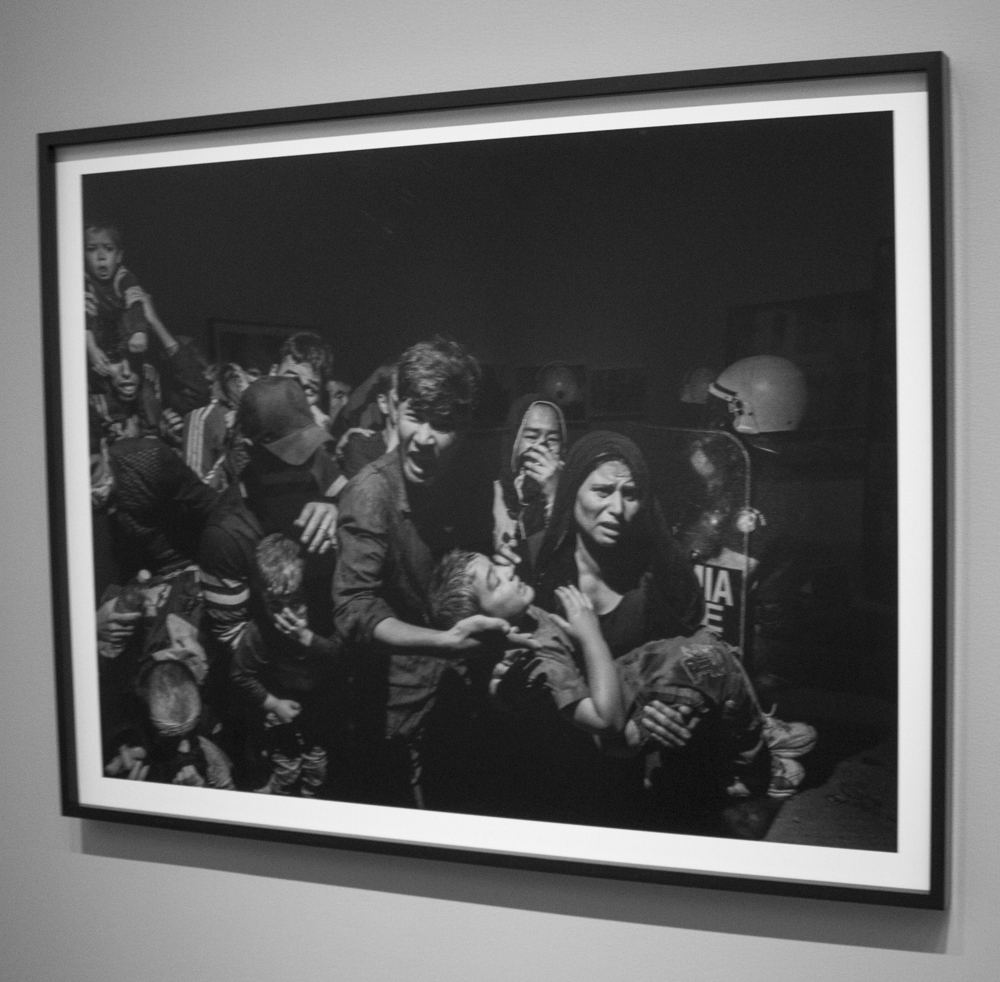
Refugees and migrants arriving on Lesbos Island, Greece (2015)
Alex Majoli
Italian
Inkjet print
"The thin line between reality and performance, documentary and art, fascinates Alex Majoli. In 2015, he traveled to Lesbos, a small island off the coast of Greece, to document the crisis of refugees fleeing conflicts in North Africa and the Mediterranean. Here, artificial lighting creates a scene that resembles a film still, but the emotions that animate the faces of his subjects are genuine. This series was intended to underscore Europe's inability to isolate itself from the suffering taking place across the Mediterranean."
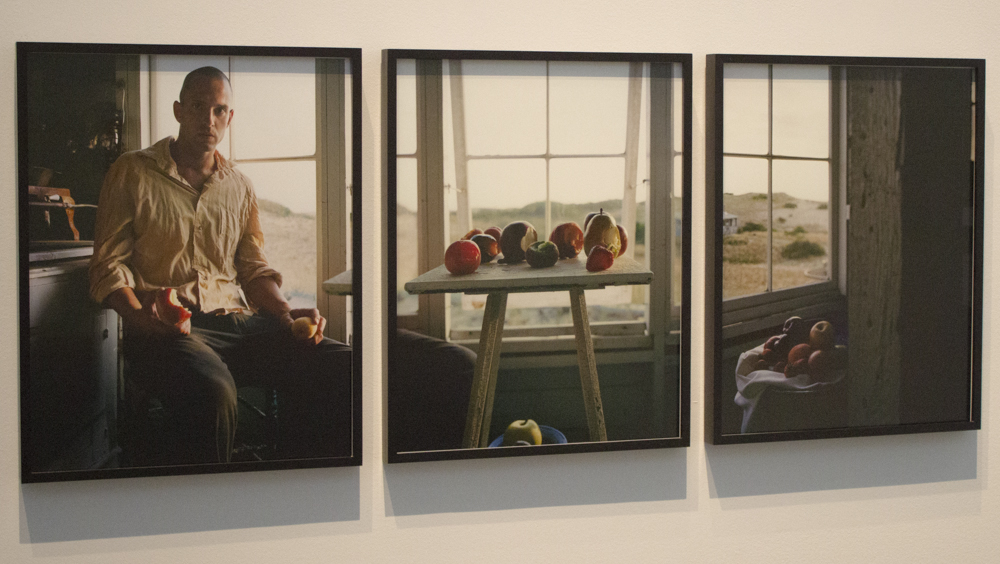
Eric Discerning (2010)
David Hilliard
American
Inkjet Print
Image of man seated on blue wooden chair in front of window. He is wearing jeans and a wrinkled shirt with the sleeves rolled up. In his right hand, he holds a partially eaten apple. Fruit (pear, strawberry, kiwi, plum, and apple) is laid out on the small white table beside him - each with a large bite taken out of them. Near the lower right is a plate filled with fruit next to a wooden post. This is one image printed across three separate sheets/mounts with narrow white margins.

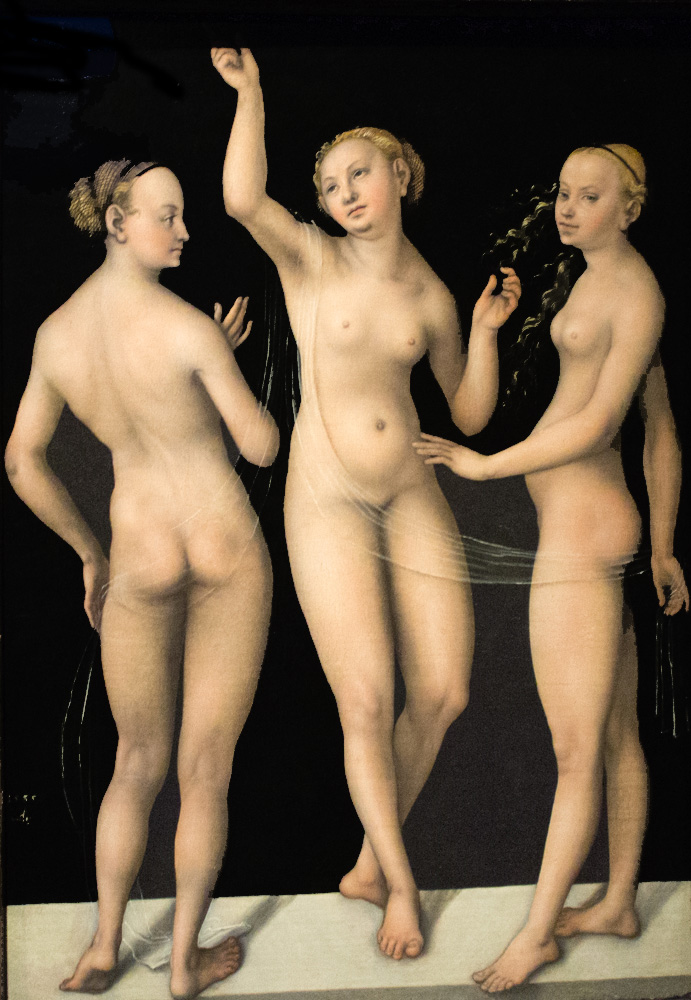
The Three Graces, 1535
Lucas Cranach the Elder
German (Wittenberg, Weimar), 1472–1553
Oil on wood panel
"The subject of the Three Graces was associated in antiquity with elegance and beauty, and the trio was oftentimes depicted as handmaidens of the goddess Venus. The Graces became popular in the Renaissance with a revival of interest in the ancient world and because of the opportunity they represented to accentuate their natural potential for sensuality. Here, Cranach's nudes illustrate this Renaissance interest, but their slender proportions are Gothic. The figures are highlighted against the dark background making their bodies look more sculptural."

“Art is the fatal net which catches these strange moments on the wing like mysterious
butterflies, fleeing the innocence and distraction of common men.” — Giorgio de Chirico
“The wings of transformation are born of patience and struggle” — Janet S. Dickens
De Kooning Breaks Through (1987)
Red Grooms (American, born 1937)
Three-dimensional color lithograph cut out, folded and assembled into a Plexiglas box
"This is a colorful and dramatic three-dimensional print that depicts a man riding a bicycle toward the viewer. A woman—with huge eyes and monumental breasts sits atop the handlebars—and the two literally breakout of the two-dimensional surface into the viewer’s space.
Red Groom's witty portrait depicts the legendary artist Willem de Kooning riding a bicycle with a woman on the handlebars. This woman is the subject of de Kooning's celebrated painting Woman and Bicycle (1952-1953).
The print parodies de Kooning's highly expressionistic painting style, as Groom's humorous portrait brims with visual puns. De Kooning is literally breaking through, suggesting the extraordinary nature of his contributions to art history."
Piece
(2011)
Archie Scott Gobber
(American, born 1965)
Enamel on canvas
Archie Scott Gobber makes art with words. Piece could refer to a "piece of art" a phrase often used in art historical texts, or it could recall other meanings for viewers. By superimposing the word piece over a peace sign, Gobber suggests that words are rarely straightforward. "Ultimately," the artist says, "my work seeks to engage the viewer as a partner in an ongoing dialogue while realizing the goal of the artwork is what it conjures."
Portrait Study of a Child
1891
Lilla Cabot Perry
American, 1848 – 1933
Oil on canvas
"Portrait Study of a Child presents Lilla Cabot Perry's poised seven-year-old daughter holding a violin. Confronting the viewer directly and by herself, this likeness of Alice Perry, unlike more sentimental depictions of children of the period, suggests the growing professionalism of women's creative endeavors throughout the late 19th century. An elite Bostonian, Perry gravitated toward an artistic career beginning in the 1870s and responded to wide-ranging influences. The firm figure drawing evident in "Portrait Study" suggests her Parisian academic training, while her focus on children reveals the impact of painter Mary Cassatt. Furthermore, the portrait's restrained palette indicates Perry's admiration of James McNeill Whistler's unconventionally poetic approach to painting."