Maverick Mist

Intertwined passions ~

  • Home
  • About
  • Contact

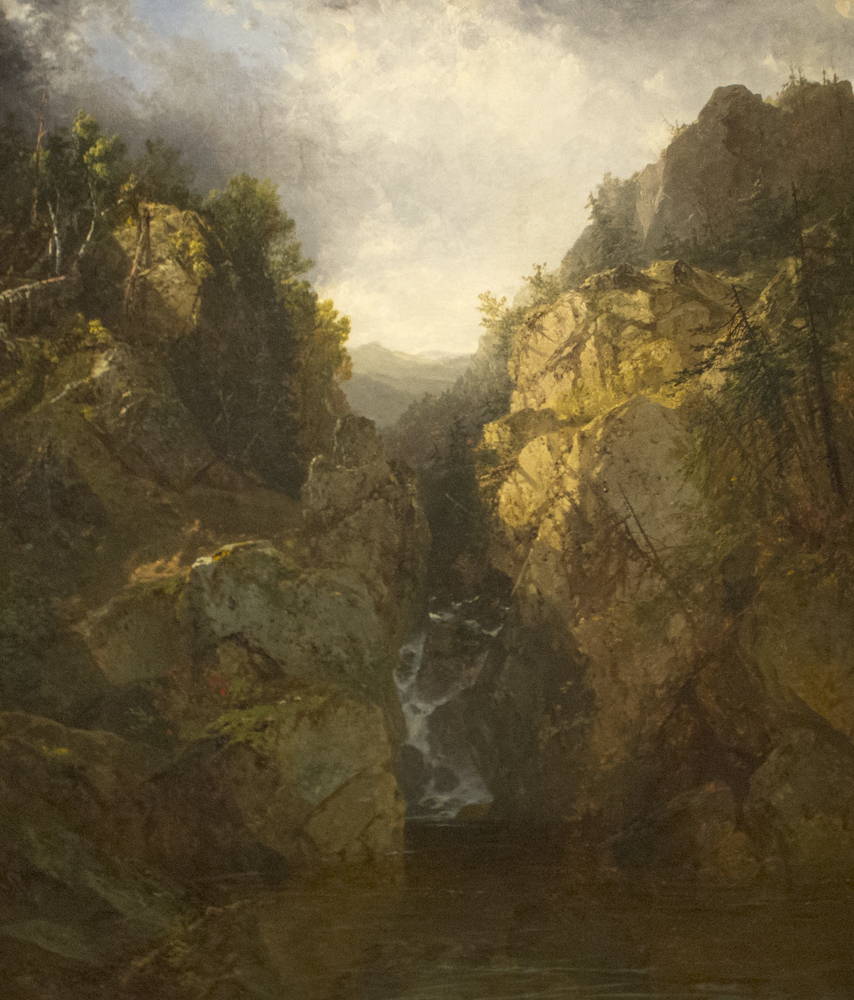
A Woodland Waterfall

Posted by Maverick ~ on July 23, 2018
Posted in: Art, Music, Nature, Photography. Tagged: 1800's, A Woodland Waterfall, American, John Frederick Kensett, Landscape, Maybe I Amazed/Waterfalls, Nelson-Atkins Museum of Art, Oil on canvas, Paul McCartney.

A Woodland Waterfall
ca. 1855-1865
John Frederick Kensett
American, 1816-1872
Oil on canvas

John Frederick Kensett embraced the aesthetic categories of the Sublime and the Beautiful shared by fellow artists and the writers Ralph Waldo Emerson and Henry David Thoreau. In A Woodland Waterfall, Kensett blended the rugged wilderness typical of Sublime landscapes with a peacefulness associated with the Beautiful. He painted the canvas with characteristic attention to detail, subtle gradations of tone and bold accents such as the orange lichen on the rocks and the red foliage to the left.

A Woodland Waterfall is loosely based on Fawn's Leap, New York, but Kensett altered its appearance for dramatic effect. One change the painter made is visible in the upper left section, where he painted over some trees on a rocky ledge to simplify the composition.  🔹

On the Road

Posted by Maverick ~ on July 22, 2018
Posted in: Art, Music, Photography. Tagged: 1800's, American, Conestoga wagon, Nelson-Atkins Museum of Art, Oil on canvas, On the Road, On the Road Again, Pennsylvania scenery, Thomas Proudley Otter, Willie Nelson.

On the Road, 1860
Thomas Proudley Otter
American, 1832-1890
Oil on canvas

On the Road is the best known work by Thomas Proudley Otter, who had a studio in Philadelphia in the late 1850s and 1860s before devoting the rest of his career to teaching. Juxtaposing new and old methods of travel-the smooth path of the sleek, fast railway train and the bumpy, circuitous route of the Conestoga wagon-Otter here praised new railroad technology and endorsed the western direction of American progress. Details such as the linear path of the train's steam and the cloudy puffs of dusts from the wagon further underscore the subject's meaning. Even so, research has uncovered that the landscape is rooted in eastern Pennsylvania scenery, and neither this type of train nor the wagon was ever used for lengthy trans-Mississippi travels.

🚌

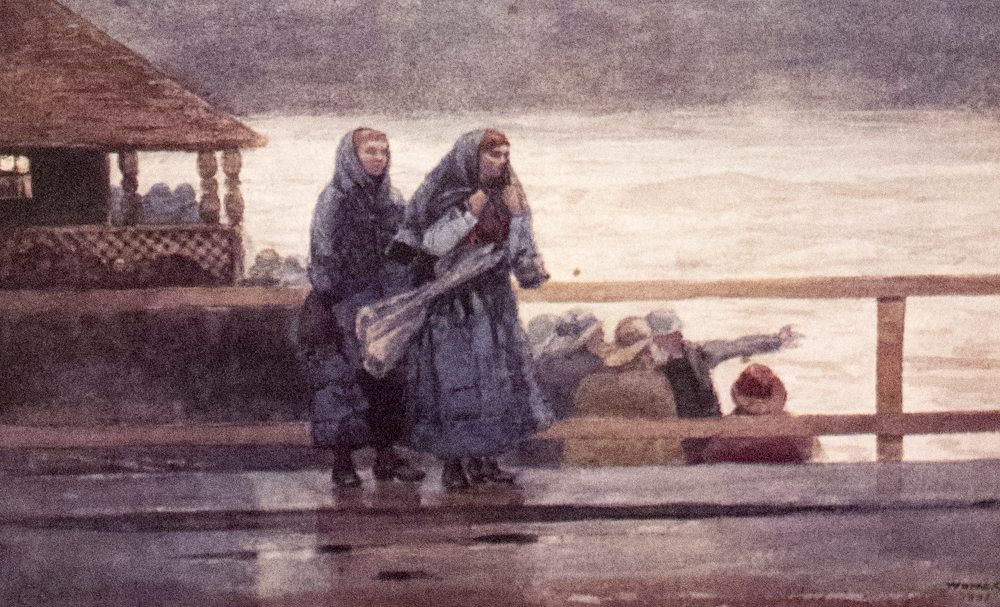
Perils of the Sea

Posted by Maverick ~ on July 21, 2018
Posted in: Art, Music, Nature, Photography. Tagged: 1888, American, Dougie Maclean, Etching on paper, nature, Nelson-Atkins Museum of Art, Perils of the Sea, Ready for the Storm, watercolor, Winslow Homer.

Perils of the Sea, 1888
Winslow Homer
American, 1836-1910

Showing fisherwomen braced against a biting wind, Winslow Homer's Perils of the Sea provides a glimpse of the small English fishing colony of Cullercoats, where the artist lived for 20 months beginning in 1881. The etching follows in reverse the subject and composition of a watercolor the artist created during his stay there years earlier. Inspired by the community's resilience against nature's wrath, Homer conveyed his respect for the fisherwomen by rendering their forms as sculptural, almost monumental and integrated tightly with the group behind them. Translating the chromatic effects of watercolor into black-and-white, the artist executed finely hatched and cross-hatched lines to evoke dynamic, extreme weather.

Natural Bridge, Virginia

Posted by Maverick ~ on July 20, 2018
Posted in: Art, Music, Nature, Photography. Tagged: 19th century, Jacob C. Ward, Lady's Bridge, Landscape, National Academy of Design, Natural Bridge Virginia, Nelson-Atkins Museum of Art, Oil on panel, Richard Hawley.

Natural Bridge, Virginia, ca. 1835
Jacob C. Ward
American, 1809-1891

Oil on panel

Jacob Ward painted the Natural Bridge in Virginia so that viewers gaze at the geological marvel from below. This low vantage point emphasizes the 200-foot height of the Bridge. Listed among the natural wonders of the world, the Natural Bridge was first owned by Thomas Jefferson, who received it from King George III in 1774.

During the early 19th century, many artists rendered the Natural Bridge because the site ranked with Niagara Falls as one of the new nation's most inspiring landmarks and tourist attractions. Such natural monuments were thought to distinguish America from Europe. Ward was one of America's first landscape painters and among the first contributors to exhibitions at the National Academy of Design in New York. *

Coffee Grinder and Glass

Posted by Maverick ~ on July 19, 2018
Posted in: Art, Music, Photography. Tagged: 1900s, Coffee Grinder and Glass, cubism, Edith Piaf, Juan Gris, Le Journal, Nelson-Atkins Museum of Art, oil on paperboard, Paris, Paris Cafe.

Coffee Grinder and Glass
Juan Gris
Spanish, 1887–1927
1915 Oil on paperboard

In this jewel-like still life, the letters "Le J" refer to Le Journal—the Paris newspaper that Juan Gris depicted in lavender on the blue top of a black table. The window blinds, coffee grinder, and wine or aperitif glass suggest that the setting may be a Paris café.

The still life was a favored subject for Gris, Pablo Picasso, Georges Braque, and other Cubists. However, their paintings are not at all still! Instead, forms are broken up and overlaid. Tabletops tilt upward, and perspective is reversed. Cubist artists, like their contemporaries in science and mathematics, explored new ideas about time, space, and motion.

☕

Landscape with a Water Mill

Posted by Maverick ~ on July 18, 2018
Posted in: Art, Music, Photography. Tagged: 1740, François Boucher, Landscape, Landscape with a Water Mill, Nelson-Atkins Museum of Art, Oil on canvas, paintings, Ronald Binge, The Watermill.


Landscape with a Water Mill (1740)
François Boucher
French, 1703-1770
Oil on canvas

French 18th-century painters would often allude to the work of their 17th-century predecessors. Here, Boucher refers to landscapes by the French classical painter Claude Lorrain, Mill on the Tiber. Both paintings feature a water mill balanced by trees on the opposite side of the composition. Furthermore, in this landscape Boucher includes a temple in the distance that is based on the Temple of the Sybil at Tivoli, another favorite classical Claudian motif. Compared to his 17th-century predecessor, Boucher applies paint more thickly, in lighter strokes, resulting in a lush, decorative density typical of the Rococo.

🖼

Allegory of Vanity

Posted by Maverick ~ on July 17, 2018
Posted in: Art, Music, Photography. Tagged: 1647-1649 Giovanni Benedetto Castiglione, Allegory of Vanity, Bacchus, Genoese, Italian, Nelson-Atkins Museum of Art, Oil on canvas, Priapus, Shocking Blue, Venus.

Allegory of Vanity
1647-1649
Giovanni Benedetto Castiglione
Italian (Genoese), 1609-1664
Oil on canvas

Castiglione was the leading Genoese artist of the 17th century, and many of his works, including this example, are rich in symbolism. The subject is encapsulated by the Latin inscription Vanitas (Vanity) on the base of the urn at the center. The vanity of sensual pleasures, intellectual pursuits and power are symbolized by the overturned urn of flowers that will soon fade and by the discarded instruments of music, science and war. Love is depicted in its most transient form, lust, by the bacchante with her tambourine in the foreground. At her feet lies a sprig of myrtle, a plant symbolizing Venus, goddess of love, and Bacchus, god of wine. The union of Venus and Bacchus produced a son, Priapus, god of lust and fertility before whose statue revelers dance in the background.

🔸

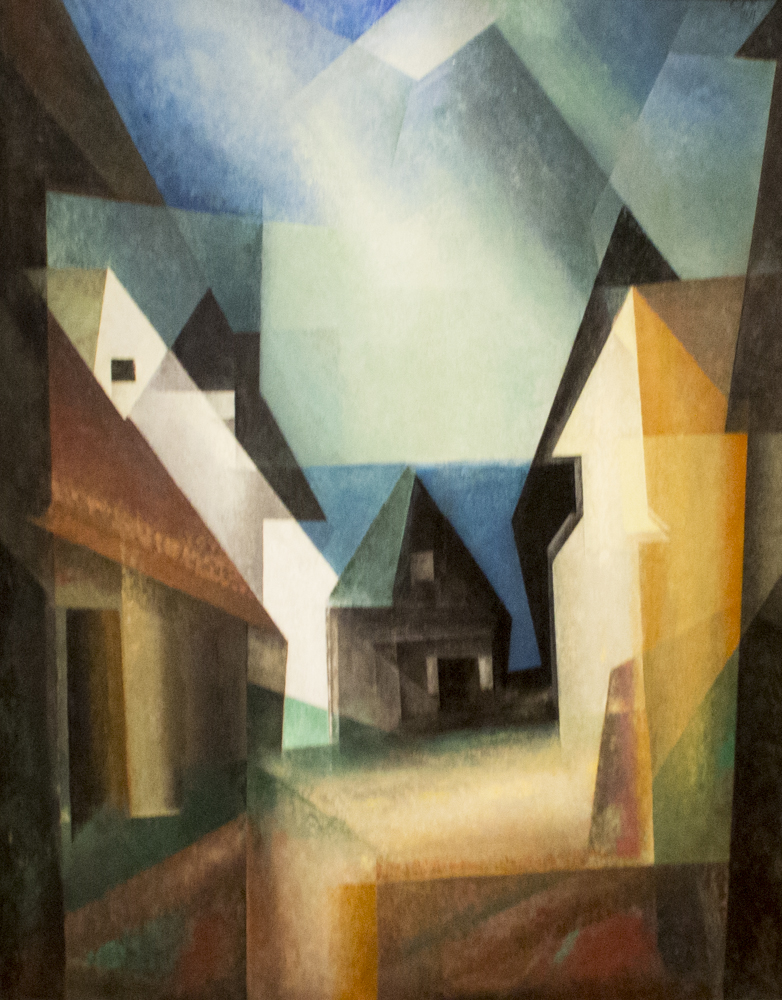
Gaberndorf II

Posted by Maverick ~ on July 16, 2018
Posted in: Art, Music, Photography. Tagged: 1924, Bauhaus, economy, efficiency, Gaberndorf II, Germany, Lyonel Feininger, Modernism, Nelson-Atkins Museum of Art, Oil on canvas mounted on board, spiritual renewal.

Gaberndorf II
Lyonel Feininger
American, 1871–1956

1924 Oil on canvas mounted on board

"Named for the small German town it depicts, Gaberndorf II features shifting, luminous planes of color. The prismatic hues may evoke the feeling of a Bach fugue, a layered musical composition of interwoven parts elaborating on a common theme. Lyonel Feininger, who called music the first influence in his life, revered Johann Sebastian Bach above all other composers.

Feininger created this painting while teaching at the Bauhaus, Germany’s innovative art and design school founded in Weimar in 1919. Dedicated to principles of economy, efficiency, and spiritual renewal, the Bauhaus (House of Construction) came to define Modernism."

🎼

Portrait of a Woman

Posted by Maverick ~ on July 15, 2018
Posted in: Art, Music, Photography. Tagged: (You Make Me Feel Like) A Natural Woman, 130-161 C.E., Antinoopolis, Aretha Franklin, Egypt, Encaustic on wood panel with gilt stucco, mummy, Nelson-Atkins Museum of Art, Portrait of a Woman, Pseudo-Plutarch, Roman Period.


Portrait of a Woman
Antinoopolis
Roman Period, 130-161 C.E.
Encaustic on wood panel with gilt stucco

This portrait of an unknown woman was made when Egypt was part of the Roman Empire. It was meant to be placed over the face of a mummy.

The portrait is arresting: her wide eyes, framed and emphasized by her heavy brows, stare out at the viewer as though she is alive today.

The artist painted it using the encaustic technique. Mixing organic colors in hot beeswax, he applied the hot paint to a specially prepared wooden board. One Greek writer, the so-called Pseudo-Plutarch, appropriately commented:

"A beautiful woman leaves in the heart of an indifferent man an image as fleeting as a painting on water. In the heart of a lover, this image is fixed with fire like an encaustic painting, which time can never erase."

🌺

Untitled (Still Life)

Posted by Maverick ~ on July 14, 2018
Posted in: Art, Flowers, Music, Photography. Tagged: 1921, Enigma, French, Nelson-Atkins Museum of Art, Oil on canvas, pink rosebuds, Suzanne Valadon, Temple of Love, Untitled (Still Life).

Untitled (Still Life)
1921 Oil on canvas
Suzanne Valadon

"Pink rosebuds and one full blossom rise from a deep blue vase in this vibrant still-life painting. Suzanne Valadon was the first woman painter to be admitted to the prestigious Société Nationale des Beaux-Arts. A child of poverty, she began working at the age of 11, selling vegetables at markets and, later, as a circus acrobat and artist model. Among her friends were fellow artists Edgar Degas, André Derain, and Pablo Picasso. She was the mother of artist Maurice Utrillo."

🌸

Posts navigation

← Older Entries
Newer Entries →
  • Blogroll

    • Art
    • Dala
    • David Francey
    • EyeEm Blog
    • LukeMD
    • Maverick Mist Photos
    • WordPress.com News
  • Links

    • An Introduction to Macro Photography
    • Annexe in Cley
    • Anrostudio
    • Artsy’s Louise Bourgeois page
    • Dala
    • David Francey
    • Face and Body Art by Mar
    • Mama's Beach Cam
    • Pablove
    • Tara Linda
    • The Where To Start Chart
  • Categories

    • Animation
    • Art
    • Flowers
    • Inspiration
    • Miscellaneous
    • Monochrome Madness
    • Music
    • Nature
    • Photography
    • Poetry
    • Uncategorized
    • Video
    • Weekly Photo Challenge
  • Archives

  • Award free but thank you for making me a nominee.

    This slideshow requires JavaScript.

Blog at WordPress.com.
Maverick Mist
Blog at WordPress.com.
  • Subscribe Subscribed
    • Maverick Mist
    • Join 3,575 other subscribers
    • Already have a WordPress.com account? Log in now.
    • Maverick Mist
    • Subscribe Subscribed
    • Sign up
    • Log in
    • Report this content
    • View site in Reader
    • Manage subscriptions
    • Collapse this bar
 

Loading Comments...