
Marriage
William Carlos Williams
So different, this man
And this woman:
A stream flowing
In a field.

Marriage
William Carlos Williams
So different, this man
And this woman:
A stream flowing
In a field.

Caja De Memoria Viva II: Constancia Colón de Clemente
Doing as others told me,
I was blind.
Coming when others called me,
I was lost.
Then I left everyone,
myself as well.
Then I found everyone,
myself as well.
~ Rumi ~

Adrian Roman’s Puerto Rican heritage and New York City upbringing inform his artistic practice. Traveling between the two places sparked an interest in exploring the disparate worlds of the tropical landscape and the overpopulated cityscape. His installations explore migration, race, and identity through memories of “observed and experienced events, repressed trauma, and childhood.” Caja De La Memoria Viva II portrays Constancia Colón de Clemente, a black Puerto Rican who migrated to the United States in the 1940s, in a three-dimensional multimedia installation that allows the viewer to literally enter Constancia’s head. This portrait and others like it permit Román to “embark on a quest to visually represent how precious our memories are and capture the dignity in the people’s struggle and validate their existence.”

“My Beloved
Know that my beloved is hidden from everyone
Know that she is beyond the belief of all beliefs
Know that in my heart she is as clear as the moon
Know that she is the life in my body and in my soul”
― Jalaluddin Mevlana Rumi – مولوی

Woman is a ray of God. She is not that earthly beloved: she is creative, not created. — Rumi

The Hand
Mary Ruefle, 1952
The teacher asks a question.
You know the answer, you suspect
you are the only one in the classroom
who knows the answer, because the person
in question is yourself, and on that
you are the greatest living authority,
but you don’t raise your hand.
You raise the top of your desk
and take out an apple.
You look out the window.
You don’t raise your hand and there is
some essential beauty in your fingers,
which aren’t even drumming, but lie
flat and peaceful.
The teacher repeats the question.
Outside the window, on an overhanging branch,
a robin is ruffling its feathers
and spring is in the air.


In the Light of One Lamp
Sean Thomas Dougherty
“I crawled into bed and closed my eyes and not long after heard the small hooves of the horses, the tiny ones that gallop in our dreams, or are they the dreams of our children, galloping through the black ruins. Everything we do is against the crippling light. To hear them cry at night is to know they are alive. When they are scared they come galloping down the long hall calling your name. Tonight, it is our oldest daughter, the red mare with her fiery mane, she snuggles in between us and falls back to sleep in your arms, to that secret place inside her, she barely moves, crossing over the river, through a grove of alders, through the black ruins, she is the one who once whispered, the grass it knows everything.”


Floorboards
Kaveh Akbar
Orchids are sprouting from the floorboards.
Orchids are gushing out from the faucets.
The cat mews orchids from his mouth.
His whiskers are also orchids.
The grass is sprouting orchids.
It is becoming mostly orchids.
The trees are filled with orchids.
The tire swing is twirling with orchids.
The sunlight on the wet cement is a white orchid.
The car’s tires leave a trail of orchids.
A bouquet of orchids lifts from its tailpipe.
Teenagers are texting each other pictures
of orchids on their phones, which are also orchids.
Old men in orchid penny loafers
furiously trade orchids.
Mothers fill bottles with warm orchids
to feed their infants, who are orchids themselves.
Their coos are a kind of orchid.
The clouds are all orchids.
They are raining orchids.
The walls are all orchids,
the teapot is an orchid,
the blank easel is an orchid,
and this cold is an orchid. Oh,
Lydia, we miss you terribly.

If you want to read the perfect love story, I recommend that you don’t read “Romeo and Juliet” but read the story of Muhammad and Aisha, in the very words of Aisha herself explaining how beautiful this relationship was between her and Prophet Muhammad (peace be upon him).
The Prophet was a loving husband. Aisha talked about the times when she enjoyed meals with him. He enjoyed his meals only when she sat next to him. They drank from one cup and he watched where she placed her lips so that he could place his lips on the same area. He ate from a bone after she ate and placed his mouth where she had eaten. She also said that he placed morsels of food into her mouth and she would do the same.
‘Aisha and the Prophet would use code language with each other denoting their love. She asked the Prophet how he would describe his love for her. The Prophet Muhammad answered, saying: “Like a strong binding knot.” The more you tug, the stronger it gets, in other words.
Every so often ‘Aisha would playfully ask, “How is the knot?” The Prophet would answer, “As strong as the first day (you asked).”

When she was asked: “What did the Prophet use to do in his house?” She replied, “He used to keep himself busy serving his family.” When one of his companions asked him “who is the most beloved to your heart?” he answered instantly “Aisha”.
Before his death, Prophet Muhammad’s very last words to his companions were: “Treat women with kindness, treat women with kindness! Have fear of God in relation to them and make sure you want well for them”.
These were his last public words concerning women which responded to the meaning of the following revealed verse regarding the life of a couple:
And of His signs is that he created for you, of yourselves, spouses, that you might repose in them, and He has set between you love and mercy. Surely in that are signs for people who consider” (The Holy Quran, 30:21)


Migrant Mother
Nipomo, California, 1936
Dorothea Lange
American, 1895-1965
Gelatin silver print (printed early 1960s)
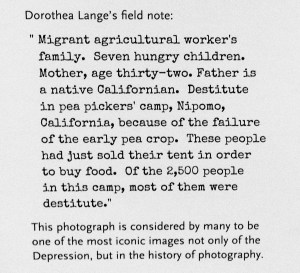
Dorothea Lange began as a professional portrait photographer in the early 1920s. The social calamity of the Depression prodded her to leave the studio to document the nation’s dispossessed. In her work for the Farm Security Administration in 1936, she recorded this migrant pea-picker, 32-year-old Florence Thompson, with three of her children. Lange had the uncanny ability to see people as both individuals and as representative types: to recognize the iconic in the ordinary. Lange’s migrant mother becomes a symbol of both strife and fortitude in the face of adversity, suggesting the condition of millions of her fellow Americans.

“Now he slept soundly through the nights, and often he dreamed of trains, and often of one particular train: He was on it; he could smell the coal smoke; a world went by. And then he was standing in that world as the sound of the train died away. A frail familiarity in these scenes hinted to him that they came from his childhood. Sometimes he woke to hear the sound of the Spokane International fading up the valley and realized he’d been hearing the locomotive as he dreamed.” ― Denis Johnson, Train Dreams

“There are only a few notes. Just variations on a theme.” ― John Lennon


 Maverick Mist