
They shall grow not old, as we that are left grow old:
 Age shall not weary them, nor the years condemn.
 At the going down of the sun and in the morning,
 We will remember them.
 Laurence Binyon

They shall grow not old, as we that are left grow old:
Age shall not weary them, nor the years condemn.
At the going down of the sun and in the morning,
We will remember them.
Laurence Binyon

Speckled Corn Katsina
Dan Namingha
Hopi-Tewa Arizona
Acrylic on canvas
"Dan Namingha has been showing professionally as an artist for 40 years. His heritage inspires his work, which explores connections between physical and the spirit world and includes of Hopi symbolism.

Drawing and painting was a natural part of Hopi childhood. It gave him a way to express his strong feelings about the culture and environment leading to a path of creative freedom. Dan feels that change and evolution are a continuum; socially, politically, spiritually and that the future of our planet and membership of the human race must be monitored to insure survival in the spirit of cultural and technology diversity. He says that only then can we merge the positive and negative polarization and balance so necessary to communal spirit of the universe." *

Bandolier Bag
Seminole Artist, Florida
About 1820-1830
Wool cloth and yarn, cotton cloth, glass beads, and silk ribbon
The bandolier bag with its freely arranged beaded design is among the rarest of all surviving beaded objects. The bags were a standard feature of men's formal dress among the Cherokee, Creek, and Seminole in the early 1800s. Women made the bags from materials acquired in trade. The Nelson-Atkins Museum now has the largest collection of such bags.
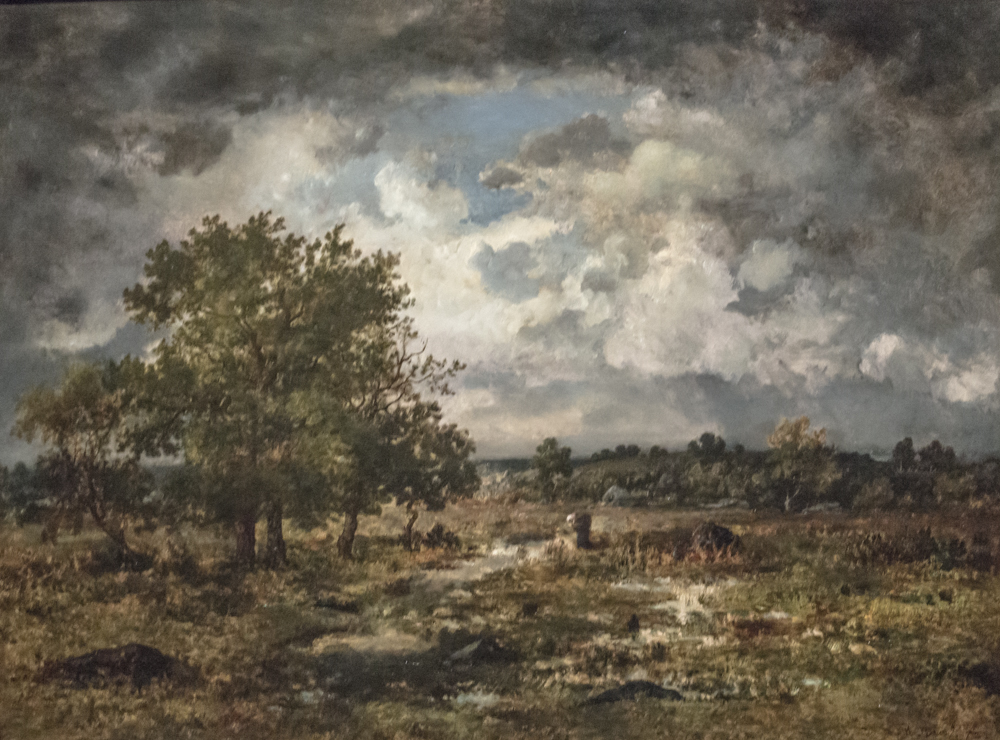
The Approaching Storm (1872)
Narcisse Virgile Diaz de la Peña
French, 1807–1876
Oil on wood panel
"As a storm begins to darken the sky, Narcisse Virgile Diaz de la Peña’s variegated, unrefined brushstrokes emphasize the rapidly changing light and atmosphere beyond a group of native oak trees. The locale, the Forest of Fontainebleau, was controversial because of its extensive plantings of Russian pine trees. The Barbizon artists strongly opposed this, viewing it as the destruction of the ancient Gallic character of the land."


“For there is no friend like a sister
In calm or stormy weather;
To cheer one on the tedious way,
To fetch one if one goes astray,
To lift one if one totters down,
To strengthen whilst one stands”
* Christina Rossetti
Goblin Market and Other Poems ▫️




“With your feet I walk
I walk with your limbs
I carry forth your body
For me your mind thinks
Your voice speaks for me
Beauty is before me
And beauty is behind me
Above and below me hovers the beautiful
I am surrounded by it
I am immersed in it
In my youth I am aware of it
And in old age I shall walk quietly
The beautiful trail.”
Navajo prayer


After Giotto
(1982-1983)
Joann Verburg
Gelatin silver print
"In Joann Verburg's lyrical, large-format photographs, figures seem to be suspended in reverie.  After Giotto, a work inspired by the Renaissance painter, echoes the formal elegance of its precedent.  The graceful gestures of the male and female figures, separated in Verburg's diptych, connect visually to one another.  The young woman's facial expression, curious yet apprehensive, suggests a moment of emotional pause, either just after or prior to an unknown event.

In 1984, Verburg and her husband, the poet Jim Moore, visited the Italian town of Spoleto. In Italy, Verburg was able to further explore her interest in paintings by Giotto. A work in the swimmers series, After Giotto (1983), makes formal references to a fresco in the Basilica di San Francesco in Assisi that depicts Isaac rejecting Esau. The facial expression, hand gesture, and apprehensive demeanor of the subject in Verburg's diptych resembles that of the woman in Giotto's work."

Paul, Marcella and Van Gogh (No. 2), ca. 1937
Paul Raphael Meltsner
American, 1905-1966
Oil on canvas
“In 1937, Meltsner painted a self-portrait titled Paul, Marcella and Van Gogh. The painting was purchased by the Luxembourg Museum in Paris, but during the German occupation of France, it was confiscated by the Nazis because Meltsner was Jewish. He painted a copy of the work in 1940, and Paul, Marcella and Van Gogh (No. 2) now hangs in the Nelson-Atkins Museum of Art in Kansas City.
This self-portrait by New Yorker Paul Meltsner features not only likenesses of his stately wife and charming wire-haired terrier, Van Gogh, but also a view of one of the artist’s industrial scenes, which brought him considerable fame in the 1930s. Holding a hammer instead of a typical brush and palette, Meltsner expresses identification with workers like the one included in the painting behind him. The composition’s smooth and volumetric forms, which appear like products of an assembly line, tie Melstner more subtly to proletarianism, a celebration of workers’ culture that attracted many American artists throughout the period. Melstner’s style translated easily and successfully into the widely accessible medium of printmaking, a pursuit that further strengthened his affiliation with 1930s proletarianism.”
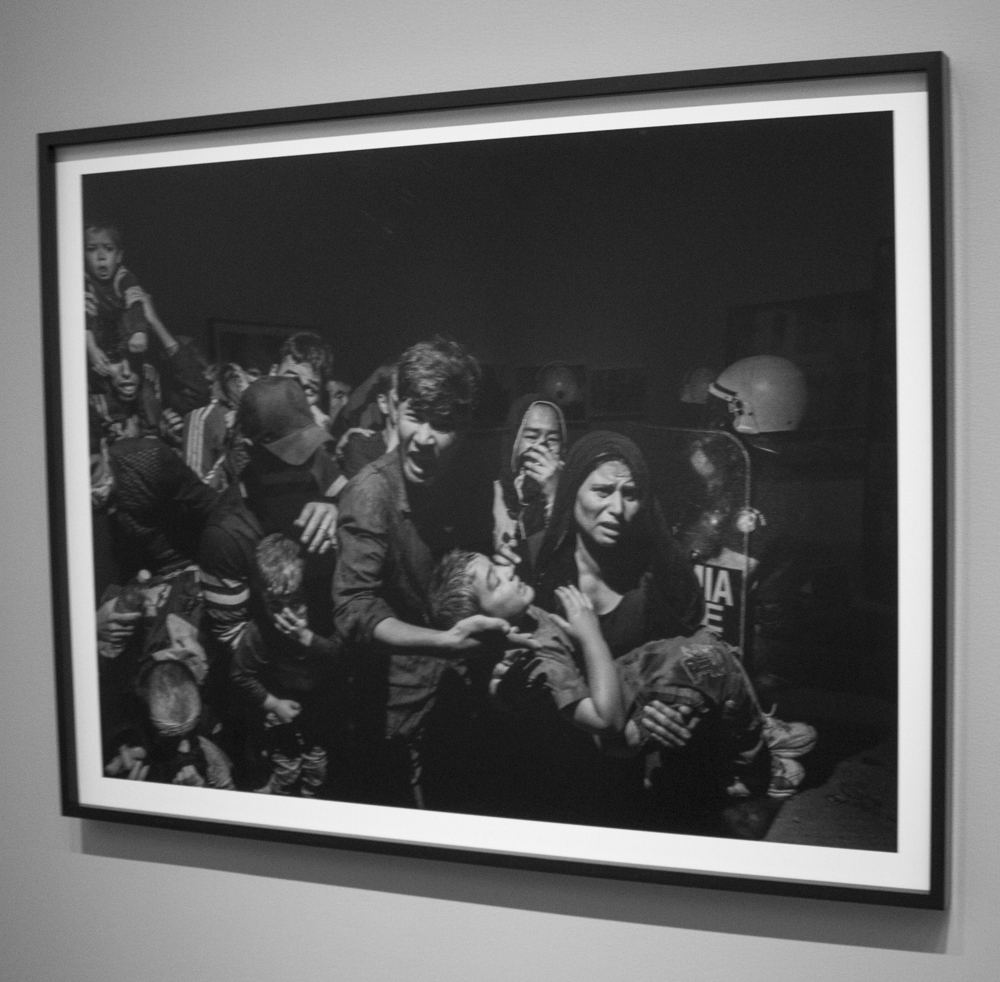
Refugees and migrants arriving on Lesbos Island, Greece (2015)
Alex Majoli
Italian
Inkjet print
"The thin line between reality and performance, documentary and art, fascinates Alex Majoli. In 2015, he traveled to Lesbos, a small island off the coast of Greece, to document the crisis of refugees fleeing conflicts in North Africa and the Mediterranean. Here, artificial lighting creates a scene that resembles a film still, but the emotions that animate the faces of his subjects are genuine. This series was intended to underscore Europe's inability to isolate itself from the suffering taking place across the Mediterranean."
 Maverick Mist