“Lovers find secret places
inside this violent world
where they make transactions
with beauty.”
― Rumi

“Lovers find secret places
inside this violent world
where they make transactions
with beauty.”
― Rumi
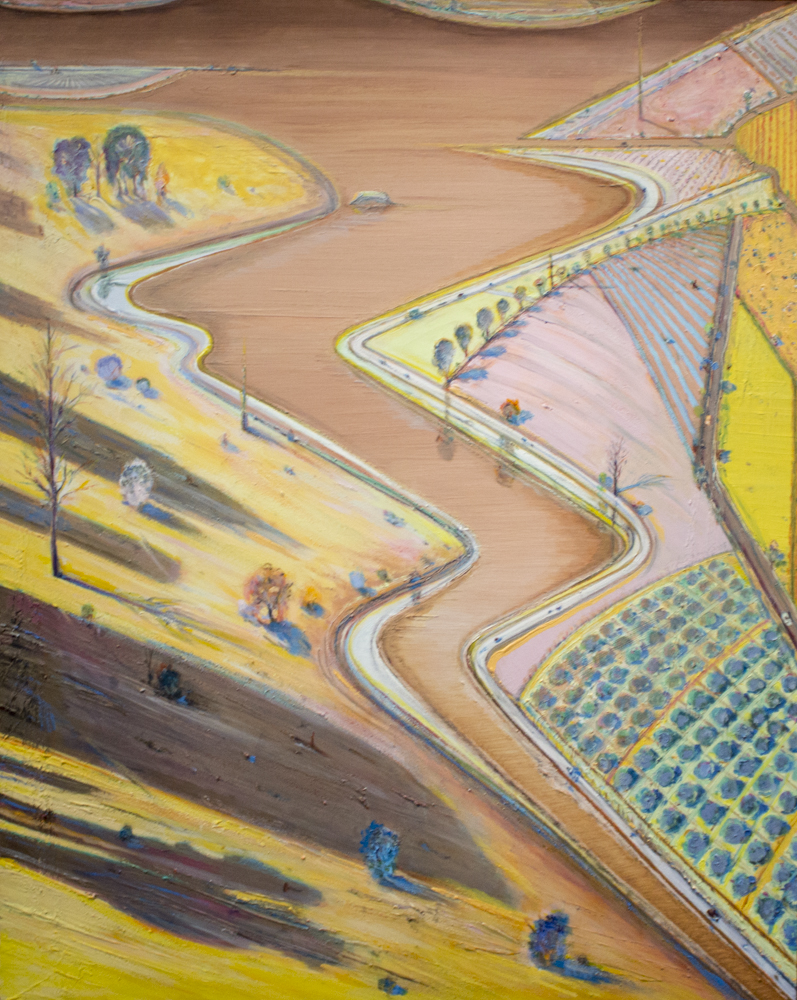
River Divide
(2007)
Wayne Thiebaud
Oil on canvas
WATER MUSIC
Sandra M. Gilbert
I. The Nature of Water
First, the clarity, those
molecules you go through and through,
and through you they go
in the long sift of blood.
And the shine goes through
as if something–you?–believes
in color, something stipulates
now blue, now what’s called
green or black. You think
you might name it landscape,
but it’s that utter
clearness, giving up
all ideas except reflection.
And then the changes, loose
and free to stiff, stiff
and still to shapeless
spirit of shape.
Do you bend today by the stream
that swivels through you?
Does it mark its currents on your skin?
Kneel in the rain and crook your fingers:
look! clear and changing
every minute
asteroids of still or shapeless

Loren Mozley (1928)
Andrew Dasburg
American, 1887–1979
Oil on canvas
"An artist’s creative decisions shape the portraits they paint. Andrew Dasburg began this painting as a portrait of a ranch worker in Taos, New Mexico. When the worker moved away, Dasburg asked his former student Loren Mozley to model. Mozley remembered posing in front of a quilt, but Dasburg ultimately decided to paint him before a simple, gray backdrop. Mozley’s checkered jacket stands out because of this choice. Its pattern likely interested the artist who included similar abstract arrangements in other paintings."

A Second Generation (aka A New Earth)
Elizabeth Catlett
(American, 1915 – 2012)
Color lithograph
For My People, illustrations for the poem by Margaret Walker
Two African American Heads viewed from the right side surrounded by white with orange and yellow brightly displayed. Across the bottom are 19 figures in blue, walking as if in protest, many with one arm raised.
For My People
by Margaret Walker
For my people everywhere singing their slave songs
repeatedly: their dirges and their ditties and their blues
and jubilees, praying their prayers nightly to an
unknown god, bending their knees humbly to an
unseen power;
For my people lending their strength to the years, to the
gone years and the now years and the maybe years,
washing ironing cooking scrubbing sewing mending
hoeing plowing digging planting pruning patching
dragging along never gaining never reaping never
knowing and never understanding;
For my playmates in the clay and dust and sand of Alabama
backyards playing baptizing and preaching and doctor
and jail and soldier and school and mama and cooking
and playhouse and concert and store and hair and
Miss Choomby and company;
For the cramped bewildered years we went to school to learn
to know the reasons why and the answers to and the
people who and the places where and the days when, in
memory of the bitter hours when we discovered we
were black and poor and small and different and nobody
cared and nobody wondered and nobody understood;
For the boys and girls who grew in spite of these things to
be man and woman, to laugh and dance and sing and
play and drink their wine and religion and success, to
marry their playmates and bear children and then die
of consumption and anemia and lynching;
For my people thronging 47th Street in Chicago and Lenox
Avenue in New York and Rampart Street in New
Orleans, lost disinherited dispossessed and happy
people filling the cabarets and taverns and other
people’s pockets and needing bread and shoes and milk and
land and money and something—something all our own;
For my people walking blindly spreading joy, losing time
being lazy, sleeping when hungry, shouting when
burdened, drinking when hopeless, tied, and shackled
and tangled among ourselves by the unseen creatures
who tower over us omnisciently and laugh;
For my people blundering and groping and floundering in
the dark of churches and schools and clubs
and societies, associations and councils and committees and
conventions, distressed and disturbed and deceived and
devoured by money-hungry glory-craving leeches,
preyed on by facile force of state and fad and novelty, by
false prophet and holy believer;
For my people standing staring trying to fashion a better way
from confusion, from hypocrisy and misunderstanding,
trying to fashion a world that will hold all the people,
all the faces, all the adams and eves and their countless generations;
Let a new earth rise. Let another world be born. Let a
bloody peace be written in the sky. Let a second
generation full of courage issue forth; let a people
loving freedom come to growth. Let a beauty full of
healing and a strength of final clenching be the pulsing
in our spirits and our blood. Let the martial songs
be written, let the dirges disappear. Let a race of men now
rise and take control.
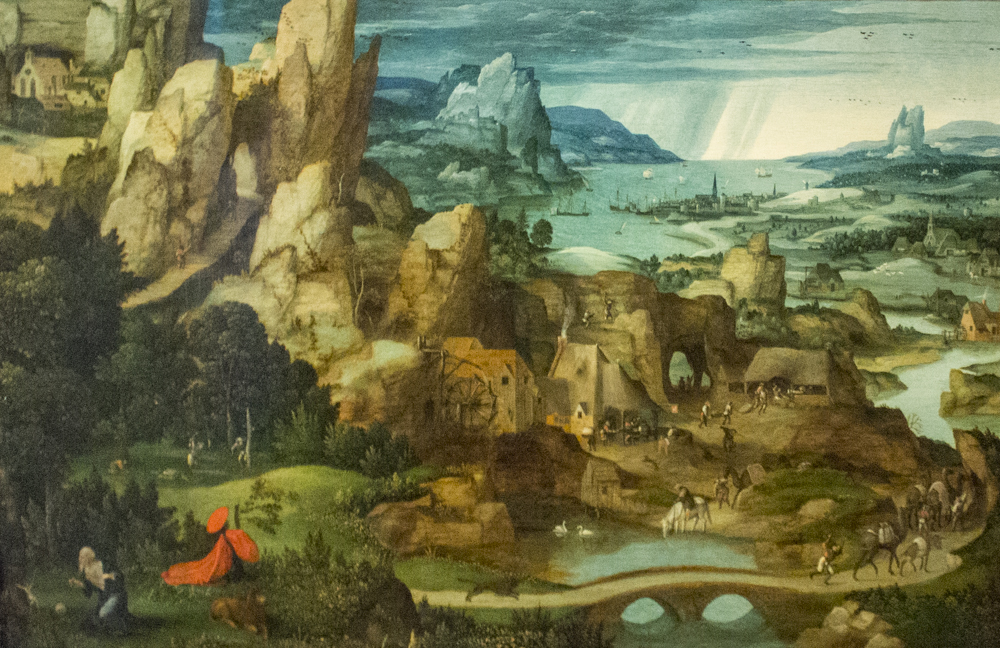
Penitent Saint Jerome in Landscape (1525-1530)
Master of the Female Half-Lengths
Flemish (Antwerp), active 1520s-1530s
Oil on wood panel
"The Master of the Female Half-Lengths is a name given to an as yet unidentified artist who worked in Antwerp and Bruges and specialized in paintings of half-length female figures. A number of landscapes have been attributed to him, including this panel. This type of panoramic landscape with jagged rocks and small figures engaged in varied activities was intended to evoke the harmony between man and the wonders of nature. Landscapes at this time were considered works of mere imitation, requiring little imaginative power, so their status was usually enhanced by endowing them with a religious subject, in this case the Penitent Saint Jerome."

The Vengeance of Hop-Frog (1898)
James Ensor
Belgian, 1860-1949
Hand-colored etching
"James Ensor used theatrical metaphors to critique the inhumanity of the world around him. In this print, he illustrates a scene from "Hop-Frog," a short story by Edgar Allan Poe. In Poe's story, Hop-Frog (a dwarf court jester so named because his physical deformity prevented him from walking upright) avenges the mistreatment that he and fellow dwarf Trippetta have suffered at the hands of the king and his entourage. Hop-Frog convinces the royal band to wear orangutan costumes, chains them together like wild beasts and leads them into a grand masquerade ball, where they gleefully terrify the guests. As seen here, in a shocking act of retribution, he hoists them to the ceiling, climbs up to "discover" their identities and "accidentally" sets them afire with his torch."

Europa and the Bull, ca. 1645
Bernardo Cavallino and follower (Johann Heinrich Schönfeld? 1609-1683)
Italian, 1616-ca. 1656
Oil on canvas
"The Latin poet Ovid, in his Metamorphoses, tells a tale of the god Jupiter, who fell in love with Europa, daughter of the Phoenician King Agenor. Jupiter, by disguising himself as a bull, succeeded in persuading Europa to climb upon his back and carried her off to the island of Crete. Like many Neapolitan artists of his generation, Cavallino was influenced by Caravaggio, who had worked in Naples, an influence apparent in the dramatic contrasts of light and shade that add drama and anticipation to this scene. There is an elfin quality to the two principal figures here, typical of Cavallino's intense but piquant style. The coarser figures in the background, however, were probably added by an assistant."
You were born together, and together you shall be forevermore.
You shall be together when the white wings of death scatter your days.
Ay, you shall be together even in the silent memory of God.
But let there be spaces in your togetherness,
And let the winds of the heavens dance between you.
Love one another, but make not a bond of love:
Let it rather be a moving sea between the shores of your souls.
Fill each other’s cup but drink not from one cup.
Give one another of your bread but eat not from the same loaf
Sing and dance together and be joyous, but let each one of you be alone,
Even as the strings of a lute are alone though they quiver with the same music.
Give your hearts, but not into each other’s keeping.
For only the hand of Life can contain your hearts.
And stand together yet not too near together:
For the pillars of the temple stand apart,
And the oak tree and the cypress grow not in each other’s shadow.
Kahlil Gibran – On Marriage
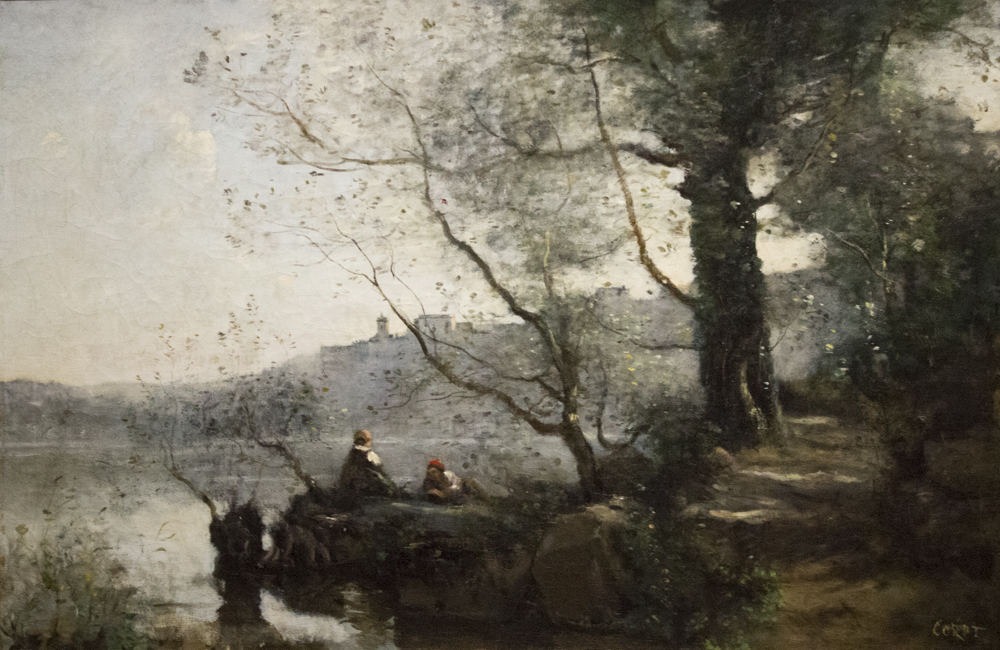
View of Lake Garda
(about 1865–1870)
Jean-Baptiste-Camille Corot
French, 1796–1875
Oil on canvas
"Jean-Baptiste-Camille Corot was one of the leading French landscape painters of the 1800s. During repeated trips to Italy between the 1820s and 1840s, he dedicated himself to painting and sketching from nature. Later in life, when he preferred to work in his Parisian studio, Corot relied on these sketches for inspiration or painted landscapes from memory. In this painting, a boatman and a contadina (Italian peasant woman) lounge on the banks of Lake Garda, a site that Corot had visited three decades earlier."
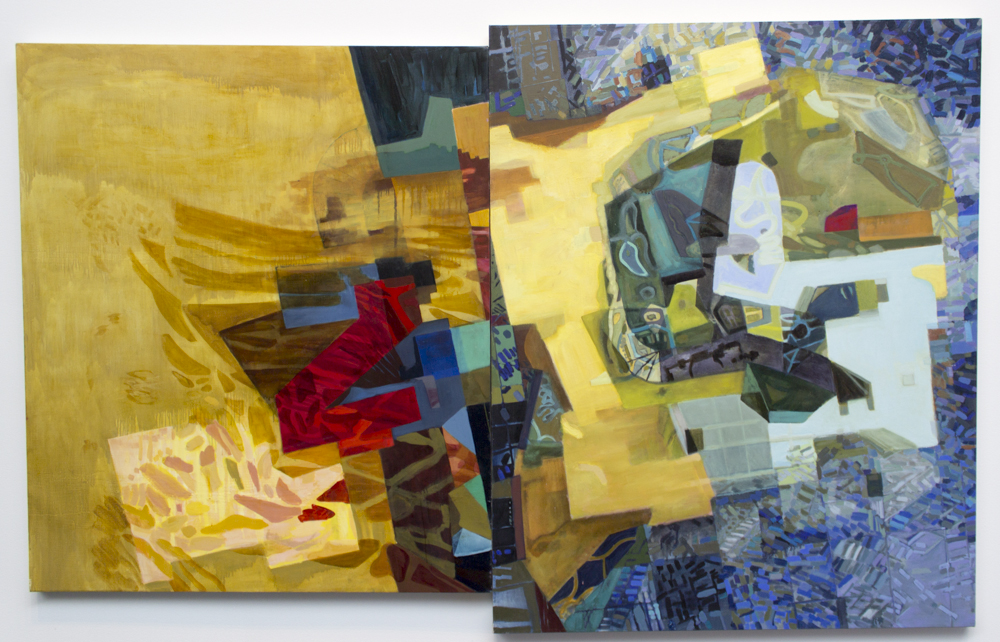
Plan B (2010)
Barbara Grad
Oil on linen
“My work is inspired by a love of paint and the fiction of painting. A strong belief in the personal visual experience is reinforced by my travels and everyday living; an integration of art and life. Familiar shapes are not recognized but create ideas or metaphors. Imagery is assembled, layered and veiled to offer multiple meanings. Abstraction enables the freedom of invention. An array of graphic figuration is referenced, including: water, air and locations. these are shapes and rhythms where man-made forms merge with aerial views and reflections. It is the juxtaposition of these components which create an invented space and visual metaphor of how our culture and physical landscape has changed and continues to advance.
Understanding a constructed mysterious illusion is realized through the paint. Imagery is created through a balance of representation and abstraction, then moments of connection and disconnection appear. Using bold flat color placed adjacent to natural light and shadow, a collision of perspectives and invented spaces are instinctively discovered. It’s an uncertain territory, where a man-made place has landscape roots and respects the beauty of nature. They are landscapes with a vague familiarity of nature that hardly exists. There are no answers, only questions of the changes confronting us.
I work in a studio, in a private way, but in relation to my world experience. I use my hands and get dirty to understand the physicality of the paint. Color needs light but can also be a pleasure. It is messy thinking and graphic imagery is a way to simplify the ideas.
Reality shapes my imagination and optimistically, my imagination shapes a painted reality.” — Barbara Grad
 Maverick Mist