
For two decades, Tim Doud has been creating his Rodney paintings, bringing his forceful gaze to bear on his equally present model, who is often draped in materials and objects that force the viewer to confront cultural display rather than likeness. As Doud’s spouse, cultural theorist Edward Ingebretsen, has noted of this series, “one remembers that on bodies and fashion hang profiling.. . . We are as we dress, for better or worse.” Doud, who has been teaching at American University since 2003, made this portrait in Washington, D.C. He explains that the referents in American Prize mix high and low culture: “when I look at the painting, I think Kentucky Derby; someone else may think high fashion or maybe Grey Gardens. It’s an all-American painting.”
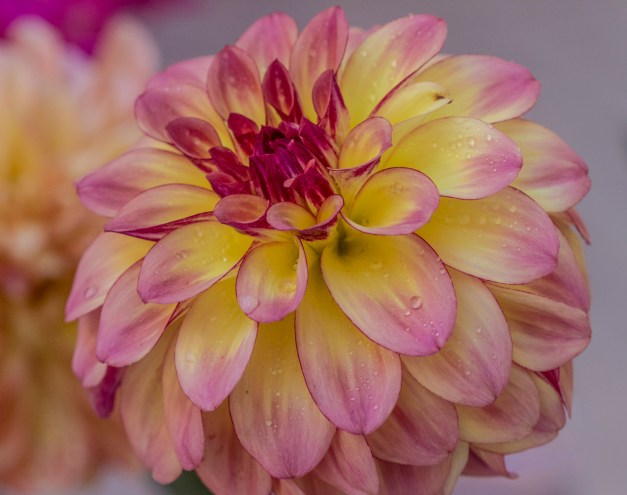
"We live in succession, in division, in parts, in particles. Meantime within man is the soul of the whole; the wise silence; the universal beauty, to which every part and particle is equally related, the eternal ONE. And this deep power in which we exist and whose beatitude is all accessible to us, is not only self-sufficing and perfect in every hour, but the act of seeing and the thing seen, the seer and the spectacle, the subject and the object, are one. We see the world piece by piece, as the sun, the moon, the animal, the tree; but the whole, of which these are shining parts, is the soul." -- Ralph Waldo Emerson


To See Beyond Its Walls
Firelei Báez
“To See Beyond Its Walls combines a large-scale painting of a female figure with a reimagined interior of Sans-Souci Palace (1813) in northern Haiti, tracing conflicted histories and current political contexts of Hispaniola (the shared island of the Dominican Republic and Haiti) and America.
The silhouette of a woman washed in vibrant teal and magenta hues appears in three-quarter profile looking directly at the viewer. Her elaborate headdress, or tignon mandated by sumptuary law in Spanish colonial Louisiana to oppress women of African descent, is filled with historical and contemporary symbols. Black panthers, emblems of the American black power movement of the 1960s, and azabache, stones carved into fists and worn in Latin American cultures to protect from evil spirits, are embedded in the painted cloth. The indigo color recalls the deep blue-violet dye originated in India and traced throughout the African slave trade. Symbols in the painted wall surface include the royal seal of the early-nineteenth-century Haitian kingdom, delicate floral patterns, hair picks, and black power fists. Báez packs the painting and wall with symbols of Latin America, the Caribbean, and America that acknowledge the complex lineage of colonial construct, resistance, and protection. They activate a space beyond the walls (of both the gallery and the palace) to imagine renewed historical and social narratives.”
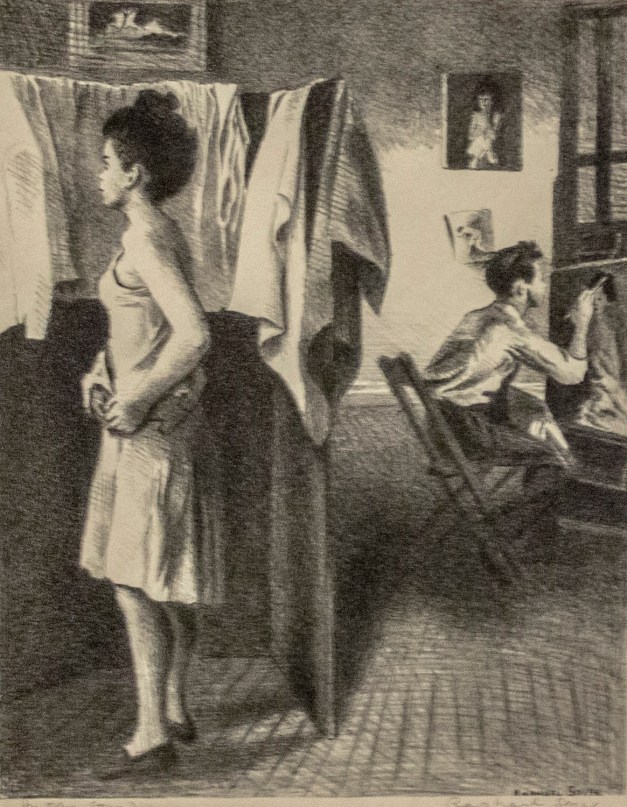
My Studio
Raphael Soyer
"In this lithograph, Raphael Soyer represented himself at work on a portrait of a model, while his subject dresses in the foreground. The artist’s face is turned, and his portrait is characterized not by his features but by the vigor with which he works. The print captures the isolation that pervades the urban scenes Soyer painted in the 1940s. Even as the artist delights in the form of his model’s body on his canvas, he is entirely separated from her physical presence in his studio."

I’ve been making a post on here every day for over the past 4 years. So now I thought might be a good time to go on hiatus and take a break during the holiday season in order to re-energize. I leave you a festival of lights along with some selected Rumi quotes. Have a happy and safe holiday season!


Les Femmes du Maroc: Grande Odalisque
Lalla Essaydi
“The compelling photograph La Grande Odalisque, by Lalla Essaydi, which references Jean-Auguste-Dominique Ingres’ famous 1814 reclining nude, La Grande Odalisque. That oil painting, residing in the Louvre in Paris, belongs to a genre that came to be known as Orientalism. The term describes the exotic and sensual way in which 19th– and early 20th-century Western artists (mostly male) depicted the Muslim culture of North Africa and the Middle East.

In her photo series Les Femmes du Maroc,which includes Le Grande Odalisque, Essaydi reacts to and in some cases recreates these Orientalist images, making subtle changes in poses and facial expressions. Her subjects are draped in white (mourning) cloth and covered in dense Arabic calligraphy done in henna. The words are largely illegible but come from the artist’s own musings about personal identity and freedom.”-Toledo Museum

Embraced: Yellow and Black
Jules Olitski
This is an abstract painting. At the lower center edge is a white ovoid form, formed with thick paint and surrounded by a few brushstrokes of blue. Above is another dark ovoid and atop it is a patch of vivid yellow. Other colors, washed across the surface, are blue, white, burgundy, purple and black. All of the colors and forms are bounded by a continuous “frame” of orange paint which appears to have been poured, rather than brushed, onto the canvas.
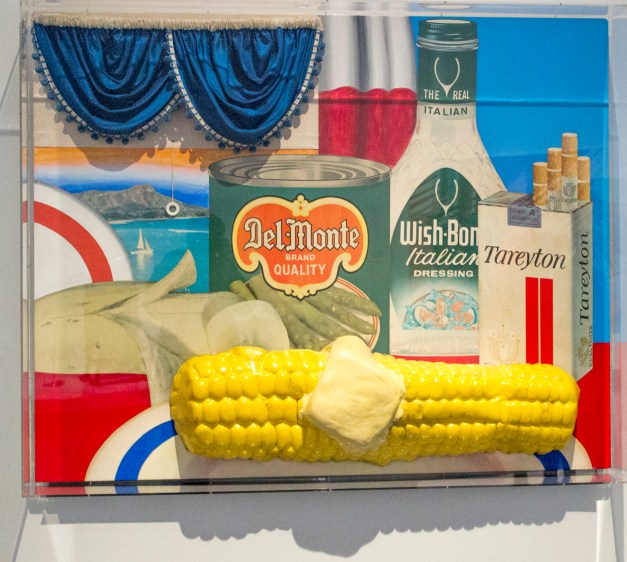
Still Life No. 24, 1962
Tom Wesselmann
Pop artist Tom Wesselmann's Still Life No. 24 affirms the American dream and the prosperity of the 1960s middle class. The variety, size and quantity of the fresh, canned and packaged convenience foods give evidence of agricultural abundance, factory productivity, and a thriving consumer economy. Television, with its myriad product advertisements, became a central force of cultural change.

Still Life No. 24 is an assemblage composed of two-dimensional imagery and three-dimensional objects. Wesselmann cut images of foodstuffs and kitchen items from subway posters and other large advertisements. The plastic ear of corn is an advertising prop, acquired by the artist from a vendor on Coney Island who sold corn on the cob.

The blue curtain is of the type pictured in magazines such as Ladies' Home Journal, which promoted interior design to the middle class. Through the window, a sailboat glides along, further suggesting the good life of the American dream.
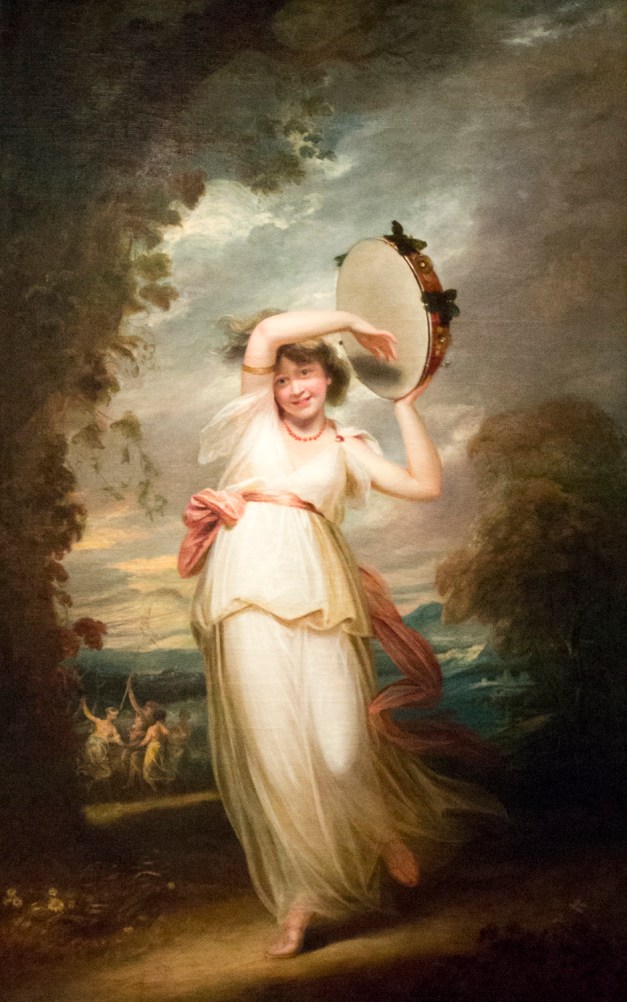
Portrait of Emily St. Clare as a Bacchante
John Hoppner
In this portrait, Emily St. Clare invites the viewer into the world of a bacchante, or follower of Bacchus, the Roman god of wine. Intoxicated by her beauty, St. Clare was the mistress of Sir John Fleming Leicester, who commissioned this and at least 13 other portraits of her from fashionable British artists.

John Hoppner was known for his restrained, formal portraits. Here, however, in striving to fulfill Leicester’s desires, Hoppner conveyed St. Clare’s youthfulness and exuberance through dynamic brushwork, flowing draperies, and an alluring smile.

Scrutiny
by Kathryne Husk
Kathryne Husk is an award-winning and nationally exhibited artist, poet, and activist. They were the recent subject of the short documentary “Kathryne: Uncensored”, and their artwork and poetry has been published in various literary journals and art magazines. Kathryne’s activist work has lead to numerous lectures and presentations on disability rights and issues facing the disability community. Their current focus is breaking down the barriers of how disabled bodies are viewed in contemporary art and in society, and bringing awareness to the lack of accessibility within the Kansas City arts scene.
 Maverick Mist