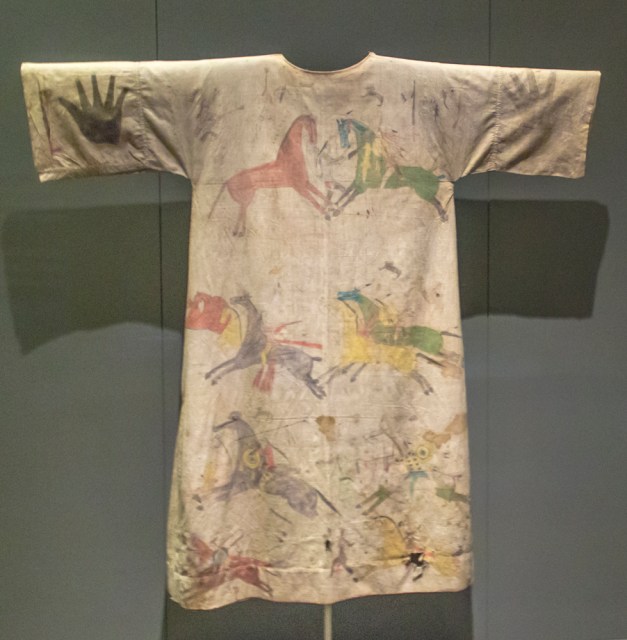
Pictographic Dress, Lakota
(Teton Sioux) (1885)
North or South Dakota
Muslin, graphite and pigment
 "Lakota, muslin dresses painted with battle scenes could be worn only by women who had lost relatives in war.  This dress belonged to Silent Woman (Ini'laon'win), whose brother, Bobtail Bear, had been killed in battle with the Crow. Painted by a male relative, the individual scenes covering the front and back of the dress represent Bobtail Bear's military exploits and accomplishments.  While each side forms and overall pictorial composition, the various episodes represent distinct events separated in time and place. Bobtail Bear's glyph, or name symbol, appears over many of the figures, thus identifying him in the actions portrayed.  Other symbols--human hands (touching the enemy), human heads (slain enemies), pipes (war parties led by Bobtail Bear) and horse tracks (enemy horses taken)--represent additional honors.”

"In the 19th century, when Mandan and Lakota warriors returned home after a battle, the tribe would hold a War Honor Dance (also called Victory or Return from Kill Dance), where women would wear pictographic dresses painted with combat scenes to honor their husbands, brothers, or sons killed in battle.  They would also wear these dresses on other ceremonial occasions.  The battle scenes were traditionally painted by male artists for the woman dressmaker, since only men could create representative art, while women would create designs, sometimes resulting from visions, that would bring power to the wearer."  *


 Maverick Mist