“Why we love with close hearts
Why we love with souls apart
Let the love flow from hearts to souls,
Let the world glow”
― Megha Khare


“Why we love with close hearts
Why we love with souls apart
Let the love flow from hearts to souls,
Let the world glow”
― Megha Khare
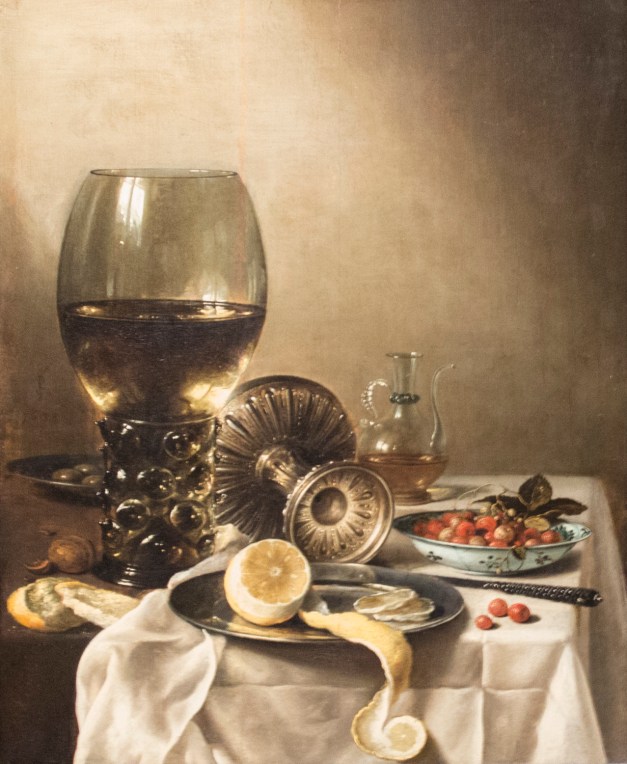
Still Life, 1638
Pieter Claesz
The 17th-century Dutch viewer would have recognized this softly illuminated still life as a representation of wealth and prosperity. The artist demonstrates his skill at depicting the various textures and reflections on the surfaces of these luxury items: a half-filled wine vessel; a silver or pewter platter and overturned cup-on-stand; a small, Chinese porcelain bowl; and a lemon, with its elegantly spiraling peel. In the porcelain bowl are wild strawberries, a delicacy typically enjoyed with French wine. The recent and seemingly abrupt departure of the person enjoying this light meal suggests the theme of vanitas, reminding us of the fleeting nature of all wealth and pleasure in our mortal state.
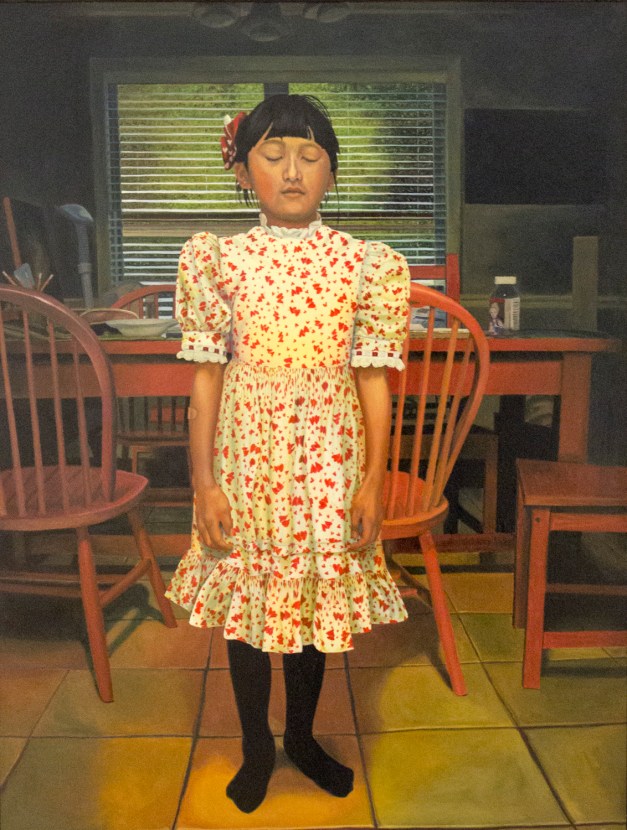
The Valentine Dress
Thu Nguyen
"Thu Nguyen’s landscape and portrait paintings are inspired by such artists as Thomas Eakins and Andrew Wyeth. She is especially interested in studying her subjects’ emotional states. In this portrait of her daughter, Nguyen depicts “the contrast between the stereotype of a carefree, sweet childhood with the reality of a life often filled with anxiety.” The girl is represented as being detached from her environment, and her rigid pose contrasts with the whimsical, heart-shaped patterns on her dress."
“This painting portrays the contrast between the stereotype of a carefree sweet childhood with the reality of a life often filled with anxiety, confusion and loneliness. While the girl is wearing a cute sentimental valentines dress, her entire posture is self contained and rigid. She is standing in a typical kitchen but seems physically and emotionally detached from her environment.” – Thu Nguyen


"Amy Sherald (born 1973) is an American painter based in Baltimore, Maryland. Her work started out autobiographical in nature, but has taken on a social context ever since she moved to Baltimore. She is best known for her portrait paintings that address social justice, as well as her choice of subjects, which are drawn from outside of the art historical narrative. Through her work, she takes a closer look at t the way people construct and perform their identities in response to political, social, and cultural expectations.”
Interview with Amy Sherald, winner of first prize at “The Outwin Boochever 2016” for her painting: “Miss Everything (Unsuppressed Deliverance).”
🐇
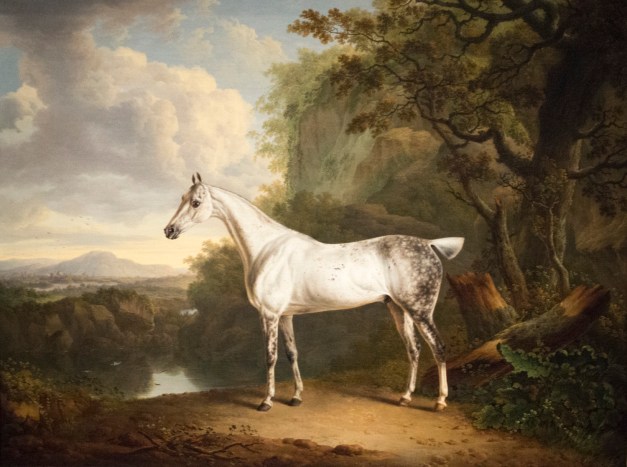
The Stallion, Gillibrand, 1817
Charles Towne
"Horses contributed significantly to Britain’s rich history and culture. They played an important role in hunting and the sport of organized horse racing. Either arena could have been where this gray stallion frolicked. Charles Towne obtained great celebrity with his portraits of working animals. Painted with diligent and affectionate care, this portrait suggests the animal’s importance to its owner. The stallion’s name, Gillibrand, could connect it to a Mr. Gillibrand who was a registered breeder of racehorses in Cheshire, near Liverpool."


“The owl,” he was saying, “is one of the most curious creatures. A bird that stays awake when the rest of the world sleeps. They can see in the dark. I find that so interesting, to be mired in reality when the rest of the world is dreaming. What does he see and what does he know that the rest of the world is missing?” ― M.J. Rose, Seduction
Friday the 13th – Seek an owl if you want a baby girl

“Incidentally, the world is magical.
Magic is simply what’s off our human scale… at the moment.” ― Vera Nazarian

Arab Horsemen
Adolf Schreyer
"Although born in Germany, Schreyer spent much of his career in Paris. Like Fromentin, whose A Ravine: Souvenir of Algeria is exhibited nearby, he was one of many artists attracted to the exoticism of Arab subjects. His visit to Algeria in 1861 probably inspired this image of an Arab chieftain, mounted on a dark horse and surrounded by his companions. Schreyer was particularly well-known as a painter of horses, and this work highlights his mastery of equine anatomy. He was also an admirer of Delacroix's rich color, and Schreyer's own sparkling brushwork is evident in his rendering of costume as well as the harnesses and tassels of the horses."
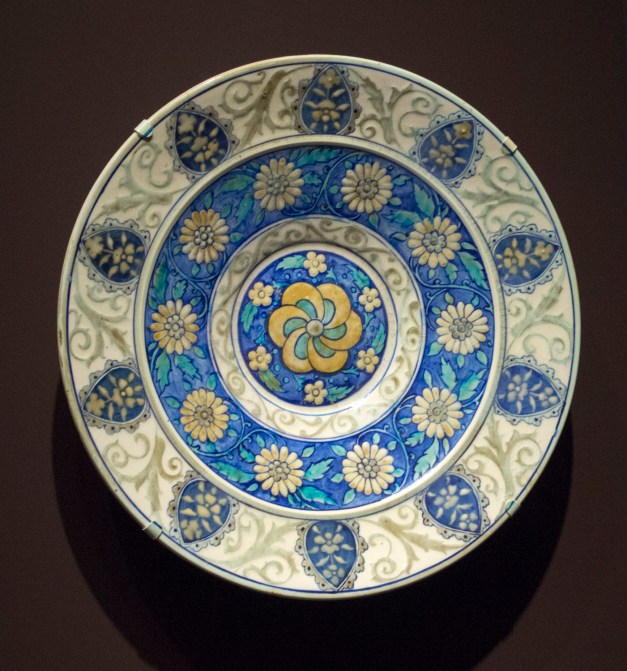
Circular Plaque, ca. 1870
Joseph-Théodore Deck
"This plaque combines designs from Islamic metalwork with the vivid coloring of Islamic ceramics. The artist, Théodore Deck, was an innovator in French ceramics during the mid-1800s (his work can also be seen in Gallery P32). Deck was fascinated with researching and reproducing lost ceramic glaze recipes, especially those found on ceramics made from the 1400s through the 1600s in Isnik (a Turkish town). The peacock blue he reinvented came to be known as Deck blue."
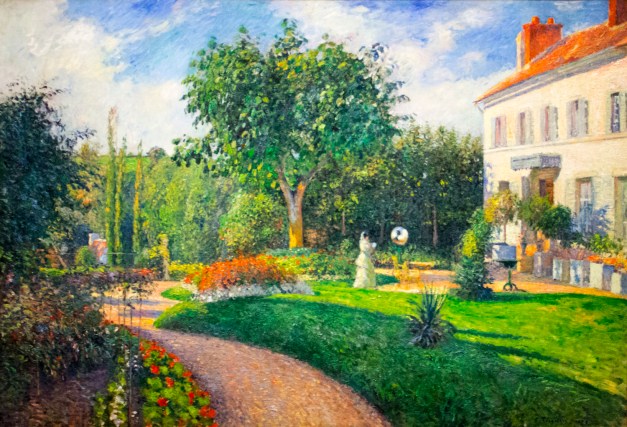
The Garden of Les Mathurins at Pontoise, 1876
Camille Pissarro
The woman in the painting is believed to be Maria Deraismes a prominent author and political figure in 1860s France who fought for women’s rights and who was a friend of Pissarro.
"This painting is an unusual subject for Pissarro, who typically preferred more rustic scenes. Here we see a comfortable, middle-class environment, whose peace and prosperity are enjoyed by the well-dressed woman in white. To her right is a glass reflecting ball, and the arrangement of the garden demonstrates the 19th-century fashion for flowers with bright, strong colors. At the time this picture was painted, Pissarro was attempting to give more structure to his loose, Impressionist style. He does so through the solid contrasts of complementary colors-red and green, blue and orange-and dense brushwork applied with small strokes." -- Nelson-Atkins Museum of Art

Lakota Instructions for Living
White Buffalo Calf Woman
Friend do it this way – that is,
whatever you do in life,
do the very best you can
with both your heart and mind.
And if you do it that way,
the Power Of The Universe
will come to your assistance,
if your heart and mind are in Unity.
When one sits in the Hoop Of The People,
one must be responsible because
All of Creation is related.
And the hurt of one is the hurt of all.
And the honor of one is the honor of all.
And whatever we do affects everything in the universe.
If you do it that way – that is,
if you truly join your heart and mind
as One – whatever you ask for,
that’s the Way It’s Going To Be.

To download a digital file of the Timeline History of the Kaw Nation, click here.

 Maverick Mist