
The fertility cycle is a cycle entirely of living creatures passing again and again through birth, growth, maturity, death, and decay. Wendell Berry
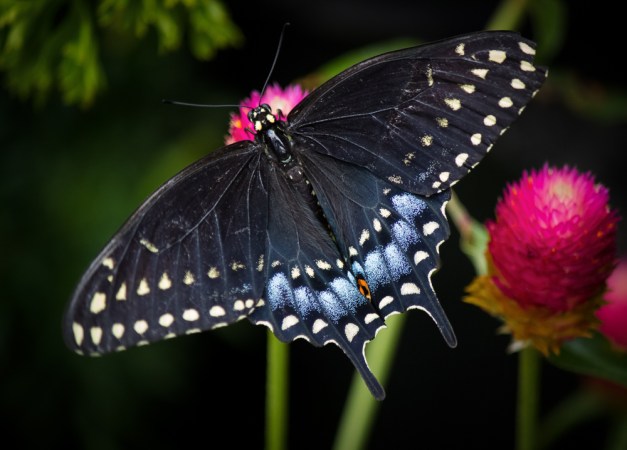
The fertility cycle is a cycle entirely of living creatures passing again and again through birth, growth, maturity, death, and decay. Wendell Berry

“Love is the bridge between you and everything.” ― Jalal al-Din Rumi
I selected the photo above from the Weekly Photo Challenge: Bridges, posted in July.
Perhaps I’m missing summer now that it’s winter because it has become much much colder.

Goodbye 2017, see you in 2018.

I’ve been making a post on here every day for over the past 4 years. So now I thought might be a good time to go on hiatus and take a break during the holiday season in order to re-energize. I leave you a festival of lights along with some selected Rumi quotes. Have a happy and safe holiday season!


Les Femmes du Maroc: Grande Odalisque
Lalla Essaydi
“The compelling photograph La Grande Odalisque, by Lalla Essaydi, which references Jean-Auguste-Dominique Ingres’ famous 1814 reclining nude, La Grande Odalisque. That oil painting, residing in the Louvre in Paris, belongs to a genre that came to be known as Orientalism. The term describes the exotic and sensual way in which 19th– and early 20th-century Western artists (mostly male) depicted the Muslim culture of North Africa and the Middle East.

In her photo series Les Femmes du Maroc,which includes Le Grande Odalisque, Essaydi reacts to and in some cases recreates these Orientalist images, making subtle changes in poses and facial expressions. Her subjects are draped in white (mourning) cloth and covered in dense Arabic calligraphy done in henna. The words are largely illegible but come from the artist’s own musings about personal identity and freedom.”-Toledo Museum

Embraced: Yellow and Black
Jules Olitski
This is an abstract painting. At the lower center edge is a white ovoid form, formed with thick paint and surrounded by a few brushstrokes of blue. Above is another dark ovoid and atop it is a patch of vivid yellow. Other colors, washed across the surface, are blue, white, burgundy, purple and black. All of the colors and forms are bounded by a continuous “frame” of orange paint which appears to have been poured, rather than brushed, onto the canvas.
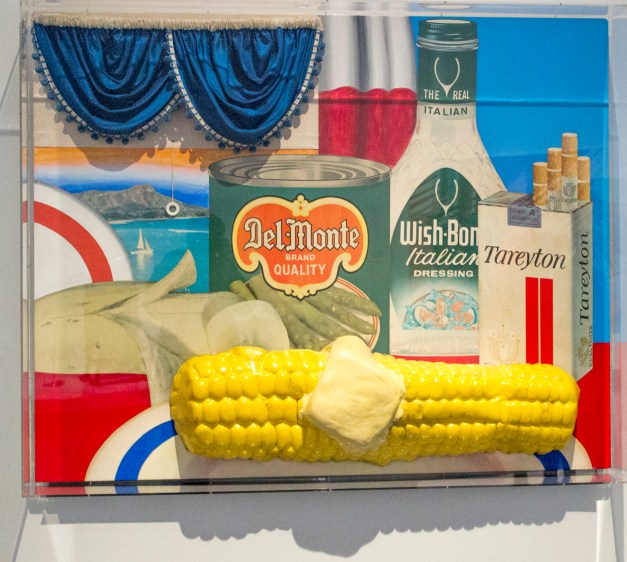
Still Life No. 24, 1962
Tom Wesselmann
Pop artist Tom Wesselmann's Still Life No. 24 affirms the American dream and the prosperity of the 1960s middle class. The variety, size and quantity of the fresh, canned and packaged convenience foods give evidence of agricultural abundance, factory productivity, and a thriving consumer economy. Television, with its myriad product advertisements, became a central force of cultural change.

Still Life No. 24 is an assemblage composed of two-dimensional imagery and three-dimensional objects. Wesselmann cut images of foodstuffs and kitchen items from subway posters and other large advertisements. The plastic ear of corn is an advertising prop, acquired by the artist from a vendor on Coney Island who sold corn on the cob.

The blue curtain is of the type pictured in magazines such as Ladies' Home Journal, which promoted interior design to the middle class. Through the window, a sailboat glides along, further suggesting the good life of the American dream.

“It is a popular belief in the Zimbabwe and Zambian regions of Africa that the meerkat is a ‘sun angel’. It is said that the ‘sun angels’ are sent by the gods to protect villages, straying cattle, and lone tribesmen from the ‘moon devil’ or werewolf. The name ‘sun angel’ was likely applied to the meerkat due to their “glowing” appearance in the morning sunlight during their routinely sun-basks.” *

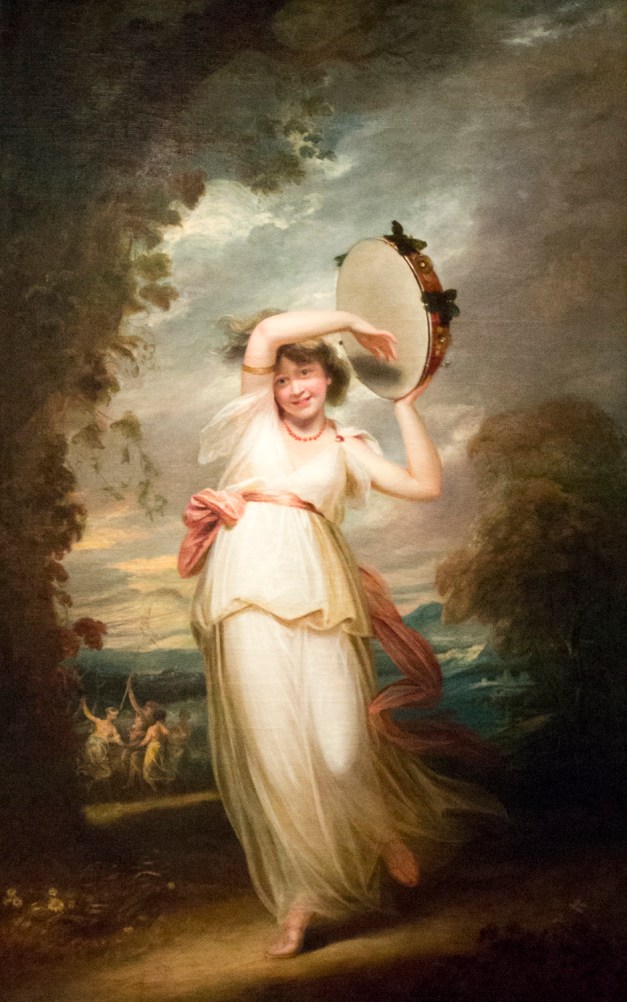
Portrait of Emily St. Clare as a Bacchante
John Hoppner
In this portrait, Emily St. Clare invites the viewer into the world of a bacchante, or follower of Bacchus, the Roman god of wine. Intoxicated by her beauty, St. Clare was the mistress of Sir John Fleming Leicester, who commissioned this and at least 13 other portraits of her from fashionable British artists.

John Hoppner was known for his restrained, formal portraits. Here, however, in striving to fulfill Leicester’s desires, Hoppner conveyed St. Clare’s youthfulness and exuberance through dynamic brushwork, flowing draperies, and an alluring smile.

Scrutiny
by Kathryne Husk
Kathryne Husk is an award-winning and nationally exhibited artist, poet, and activist. They were the recent subject of the short documentary “Kathryne: Uncensored”, and their artwork and poetry has been published in various literary journals and art magazines. Kathryne’s activist work has lead to numerous lectures and presentations on disability rights and issues facing the disability community. Their current focus is breaking down the barriers of how disabled bodies are viewed in contemporary art and in society, and bringing awareness to the lack of accessibility within the Kansas City arts scene.

Dell at Helmingham Park
John Constable
John Constable’s personal vision and immediate encounters with nature shaped his landscape paintings. This approach links him to a central tenant of Romanticism. While earlier British artists aspired to represent an idealized view of an imagined landscape, Constable strove to capture the local scenery of his native Suffolk, England.
Constable's intimate vision, as exemplified by this work, was characteristic of the newly intensified attitude toward nature adopted by the Romantic movement. He first visited this dell in 1800, when he wrote to a friend, "Here I am quite alone among the oaks and solitude of Helmingham Park… there are abundance of fine trees of all sorts." He visited once more in 1814, but this is a late work of memory. Constable enhances the rustic atmosphere by including a foreground cow and, in the distance, a stag and red deer. His technique is loose and free, making his trees appear as though they are sighing and swaying in the wind.
 Maverick Mist